

A Fuel Theft Prevention Example That Scales
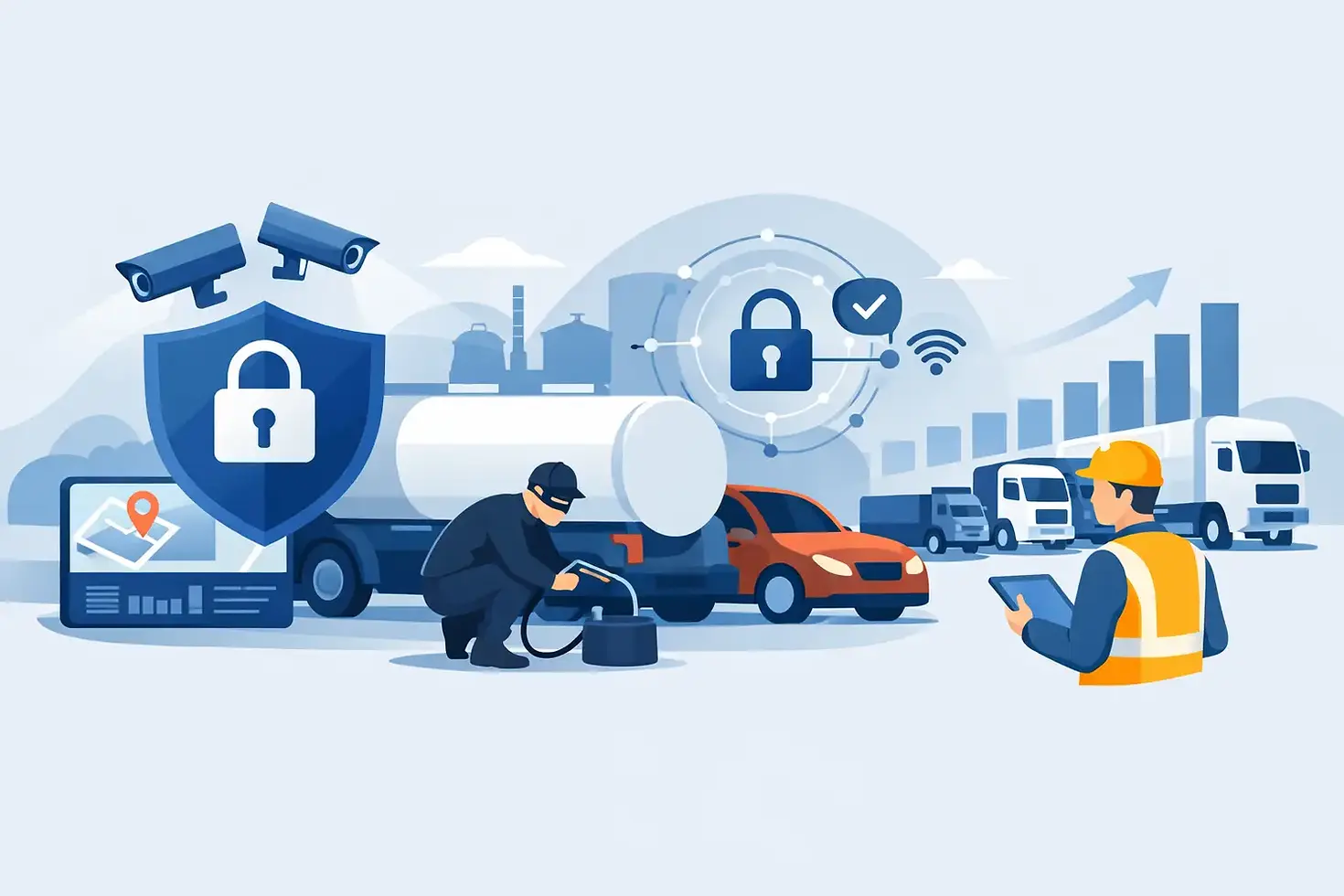
A tanker loses 35 gallons during an overnight stop. The driver returns to a normal route, fuel card activity looks legitimate, and the only visible sign is a lower-than-expected fuel level the following morning. This fuel theft prevention example shows why periodic fuel reports alone are not enough. Fleet operators need a system that identifies the drain event, verifies its context, and gives the operations team time to respond.
For commercial fleets, fuel theft is not one problem with one cause. It can involve siphoning from a parked vehicle, unauthorized refueling, fuel-card misuse, tank manipulation, or gradual losses hidden inside normal consumption variation. The practical objective is not simply to install a sensor. It is to create an evidence-based operating process that turns fuel data into accountable action.
The fuel theft prevention example: from loss to proof
Consider a regional fleet operating 80 diesel trucks. Each vehicle makes scheduled deliveries, parks at a mix of company yards and unsecured customer locations, and has a typical fuel consumption range that varies by load, traffic, idling, and route profile. The fleet has historically reviewed fuel purchases and monthly consumption, but it cannot reliably separate operational variance from theft.
The operator installs continuous tank-level monitoring on higher-risk vehicles, paired with GPS tracking, ignition status, and geofencing. The fuel sensor measures changes in the tank independently of fuel-card transactions. The telematics platform receives the readings alongside vehicle location, motion, and operating state.
At 2:14 a.m., a parked truck records a rapid 28-gallon fuel-level decrease over seven minutes. The ignition is off, vehicle speed is zero, and there is no authorized refueling event. The location is outside the company's secured yard geofence. Rather than waiting for an exception report the next day, the system classifies the event as a suspected drain and sends an alert to the designated control team.
The alert alone does not prove theft. It creates a high-priority event that can be reviewed against the full operating context. The operator checks the tank-level graph, GPS position, ignition state, prior fuel quantity, and the vehicle's planned stop. The pattern is inconsistent with normal use, sensor noise, or a fuel fill. It is logged, escalated according to policy, and compared with any available camera footage or driver report.
That is the difference between a useful system and a generic alarm. The fleet has a time-stamped record of what changed, where it occurred, and under what vehicle conditions.
Why tank-level data needs vehicle context
A fuel-level decrease is not automatically theft. Fuel expands and contracts with temperature, a vehicle may be parked on an incline, and raw readings can shift during movement. A poorly configured alerting rule can create false positives, which reduces trust in the system and causes teams to ignore legitimate warnings.
Reliable prevention depends on correlating several signals. Tank-level change identifies the potential loss. Ignition status and speed help distinguish a drain from consumption during operation. GPS location identifies whether the event happened at an approved depot, a fuel station, or an unplanned stop. Time of day, driver assignment, route schedule, and fuel-card data add operational context.
A practical rule might trigger only when a fuel decrease exceeds a defined volume within a short period while the vehicle is stationary and ignition-off. The threshold should be tailored to the tank size, sensor resolution, vehicle type, and normal operating conditions. A 10-gallon threshold may make sense for one light commercial application but be too sensitive or too high for another.
This is also why installation quality matters. The sensor must be selected and calibrated for the tank design and fuel type, mounted securely, and validated through controlled fills and drains. For fleets with diverse vehicle classes, one configuration should not be assumed to fit every asset.
Build a response workflow, not just an alert
Fuel theft prevention fails when alerts arrive without clear ownership. A fleet manager may receive a notification after hours, but if there is no escalation process, the event becomes another dashboard entry rather than an operational control.
The response should match the risk level. For a suspected active siphoning event, the fleet may notify the driver or security team, verify vehicle location, and direct the driver not to approach an unsafe situation. For a historical event discovered after the fact, the process may focus on evidence preservation, route review, claim documentation, and pattern analysis.
A well-defined workflow should specify four elements:
Who receives real-time suspected-drain alerts and during which hours.
What evidence must be checked before an event is classified as likely theft.
Which actions are appropriate for the driver, dispatcher, security team, and fleet manager.
How confirmed incidents are documented and used to adjust routes, parking policies, or security controls.
The objective is not to create a punitive environment for drivers. It is to protect drivers, equipment, and operating margin while ensuring that genuine anomalies receive a consistent investigation.
Use data to identify risk patterns
One incident may be isolated. Repeated suspected drains in the same location, time window, or route segment indicate a control gap. Over several weeks, fleet managers can use event data to identify where the risk is concentrated.
For example, an operator may find that losses occur primarily at three unsecured overnight parking locations. The appropriate action might be to change parking arrangements, add site lighting or access controls, revise route timing, or require parking within a defined geofence. If events follow a particular vehicle group rather than a location, the investigation may shift toward tank hardware, assignment procedures, or unauthorized access.
This approach produces a more accurate business case than estimating fuel theft from aggregate monthly variance. The fleet can measure suspected drain volume, confirmed losses, response time, repeat locations, and loss reduction after controls are introduced. Those metrics are useful for internal operations and for telematics service providers building a value proposition for fleet customers.
Select technology for deployment reality
A fuel monitoring project must work in field conditions, not only in a demonstration. Commercial vehicles experience vibration, dust, temperature changes, variable power conditions, and inconsistent mobile coverage. Hardware selection should account for sensor accuracy, enclosure durability, installation method, connectivity, integration options, and the diagnostic tools available to installers.
For some fleets, wired tank-level sensing is appropriate because it provides continuous measurement and supports detailed analysis. For other assets, a wireless fuel sensor may reduce installation time and avoid additional cabling. The correct choice depends on the tank construction, deployment scale, maintenance model, and required reporting precision.
The telematics device also needs enough input capability and firmware flexibility to support the intended logic. GPS location, ignition detection, digital inputs, CANBUS data where available, and configurable event rules all affect the quality of the final solution. A system that cannot connect fuel events to vehicle state will provide less useful evidence.
For B2B providers, platform integration is equally important. Device data should be available through the fleet management environment used by dispatchers and customers, with event definitions that can be adapted by market, vehicle class, and operating policy. ERM Telematics supports this kind of modular deployment model through connected hardware designed for fleet and asset-control applications.
Balance prevention with operational practicality
The strongest fuel-control policy is rarely the most restrictive one. Requiring every driver to park only at a central depot may reduce risk but can add route miles, delay deliveries, and reduce hours-of-service flexibility. Similarly, setting very aggressive alert thresholds may overwhelm the control team with exceptions.
The better approach is targeted control. Apply higher monitoring sensitivity to high-value vehicles, remote routes, recurring theft locations, or overnight stops. Use different rules for long-haul tractors, construction equipment, refrigerated vehicles, and local delivery vans. Review alert outcomes regularly, then refine thresholds based on verified events rather than assumptions.
Driver communication also matters. Drivers should understand that fuel monitoring protects the operation and helps resolve disputes with factual data. When an incident occurs, a clear process prevents drivers from being blamed for losses they did not cause and gives managers a consistent basis for investigation.
Turn the first event into a stronger fleet control
The value of a fuel theft system is not limited to catching a single drain. Each verified event improves the fleet's understanding of exposure, whether that means a vulnerable parking location, an installation issue, an unapproved refueling practice, or a gap in overnight security.
Start with a defined set of high-risk vehicles, validate sensor readings under real operating conditions, and establish response ownership before expanding deployment. A properly engineered system makes fuel loss visible when it happens, but its greater value is the operational discipline that follows: better evidence, faster decisions, and fewer opportunities for theft to remain hidden.


