

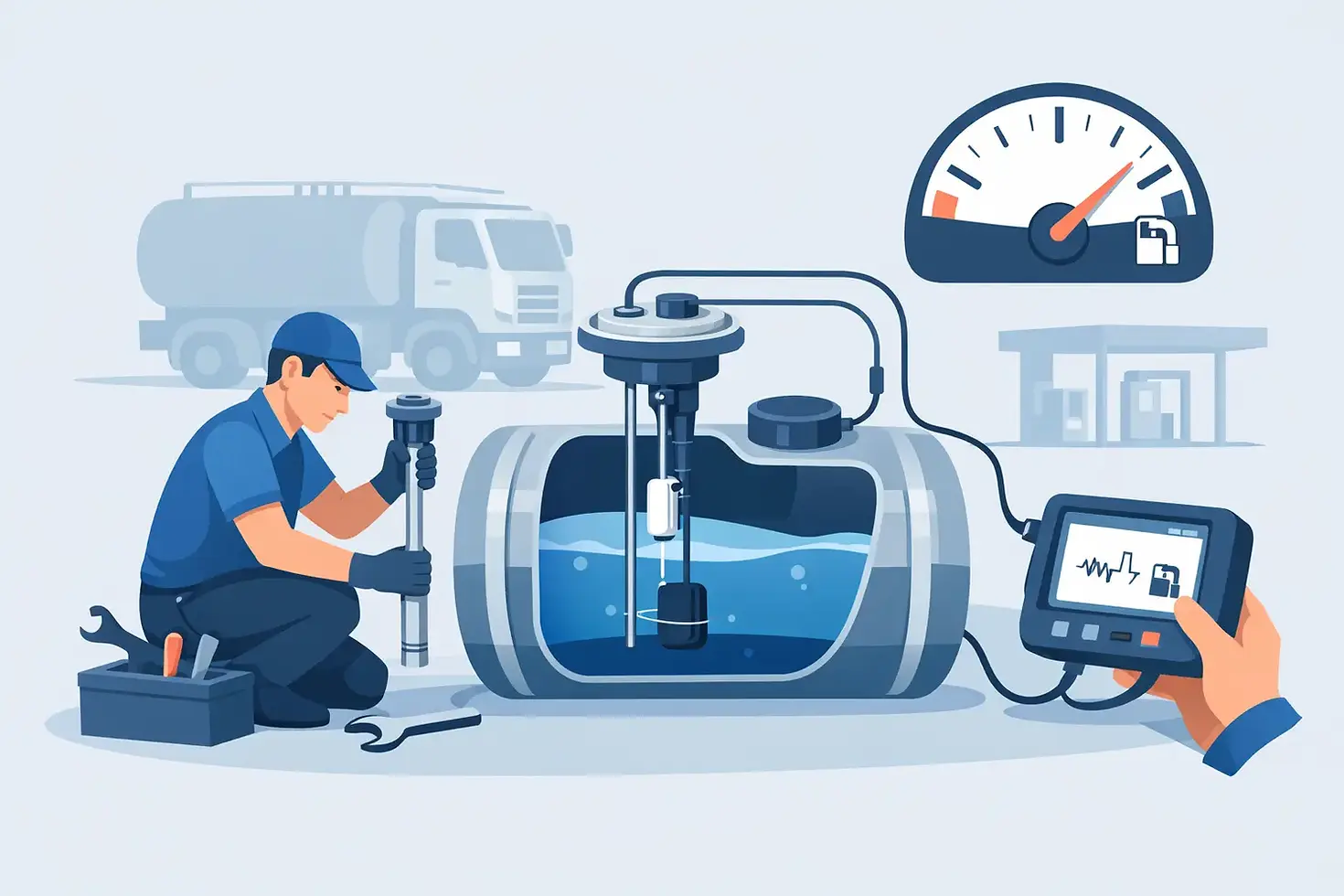
How to Install Fuel Sensors Correctly
A fuel sensor that reads perfectly on the bench can still fail in the field for one simple reason - installation quality. In fleet operations, the question is not just how to install fuel sensors, but how to install them so the data stays accurate across vibration, temperature swings, driver behavior, and long service cycles. If the install is rushed, the platform will report noise instead of insight.
Why installation quality matters
Fuel monitoring is usually deployed to solve a business problem: unexplained consumption, suspected theft, refill verification, route-level fuel analysis, or tighter control over high-value assets. Those outcomes depend on stable measurement. A poorly mounted probe, weak ground, incorrect tank mapping, or bad calibration can create false drains, missed refills, and support overhead that quickly erodes trust in the system.
This is why fuel sensor installation should be treated as part of system engineering, not just hardware fitting. The sensor, telematics device, vehicle electrical system, tank geometry, and software rules all affect the result. On mixed fleets, small variations between trucks can produce large differences in data quality.
How to install fuel sensors: start with the tank and use case
Before drilling, wiring, or pairing anything, define what you are measuring and on which vehicle class. A rigid commercial truck tank behaves differently from a saddle tank setup, and both differ from generator tanks, refrigerated units, or off-road machinery. Tank depth, shape, baffles, and fuel movement under load all influence sensor selection and placement.
The first technical decision is whether the application calls for an in-tank level sensor, a non-invasive wireless sensor, or data acquisition through the vehicle CANBUS when supported and validated. Direct tank measurement often gives the most independent visibility, especially where anti-theft control is the goal. CAN-based data can reduce installation time, but it depends on vehicle make, model, protocol access, and data consistency. In practice, many integrators choose the method that best fits the fleet’s operating environment rather than the method that looks simplest on paper.
For tank-mounted sensors, inspect the tank physically. Confirm material, wall thickness, tank depth, access points, and whether there is a safe flat mounting surface. Also check for internal obstructions and reserve enough clearance for the sensor probe or mounting hardware. If the tank has severe irregularities or multiple chambers, calibration will matter more than usual.
Prepare the vehicle before installation
A controlled installation starts with safety and repeatability. Depower the vehicle where required by the installation protocol, secure the work area, and reduce ignition risks. Fuel system work should always follow the vehicle manufacturer’s safety guidance and local handling procedures.
Then document the baseline. Record vehicle ID, tank dimensions, nominal capacity, existing telematics hardware, and the exact installation point. For fleet-scale deployments, this discipline pays off later when support teams need to compare performance across sites or installers.
It is also the right stage to plan cable routing. Fuel sensor wiring should be protected from abrasion, heat, water ingress, and mechanical pull. A sensor may be specified as rugged, but exposed routing near moving parts or exhaust heat can still shorten its service life.
Installing an in-tank fuel sensor
For fleets that need high-resolution level measurement, in-tank capacitive or similar probe-based sensors are common. Here, mechanical precision matters.
Choose the right mounting point
The best mounting point is usually the flattest practical area near the geometrical center of the tank, where the sensor can measure a representative fuel level. Avoid locations too close to the tank wall, filler neck, or areas with excessive turbulence. If the tank includes baffles, confirm the sensor position will not interfere with them and will still read the primary fuel chamber correctly.
A common mistake is choosing the easiest drilling point instead of the best measurement point. That saves minutes during installation and creates years of inconsistent reporting.
Measure and cut the sensor correctly
If the sensor probe must be trimmed to tank depth, measure twice and account for the required bottom clearance defined by the manufacturer. Too long, and the sensor may bottom out or sit under stress. Too short, and you lose usable measurement range at low fuel levels.
After cutting, finish the sensor end as specified so there are no burrs or damage that could affect performance. This step is small, but it affects calibration quality and long-term reliability.
Mount and seal the assembly
Once the opening is prepared, mount the sensor using the recommended gasket, fasteners, and torque values. The seal has to withstand fuel vapor, vibration, and long operating hours. Over-tightening can deform the mounting surface. Under-tightening can create leaks or vapor issues.
Installers should also think ahead to maintenance. A neat, well-oriented installation makes later inspection and replacement much easier, especially in large fleets where service time has a direct cost.
Wiring and integration with the telematics unit
The sensor only becomes operationally useful when its data reaches the platform cleanly. That means power, ground, signal integrity, and device configuration all need attention.
Power and grounding
Use a stable power source within the sensor’s rated range and avoid noisy circuits when possible. Grounding should be direct and consistent with telematics installation best practice. Shared or weak grounds are a frequent source of drifting values and intermittent faults.
Where the telematics device supports analog, frequency, RS232, RS485, or wireless inputs, match the sensor output method carefully. The wrong interface mapping can look like a failed sensor when the issue is only configuration.
Cable routing and protection
Route cables through protected channels, use automotive-grade sleeving or loom where needed, and secure the harness with proper strain relief. Water ingress around entry points is a common field issue, especially on vehicles operating in harsh weather, washdown cycles, or off-road conditions.
For large fleet programs, standardized harness routing is worth enforcing. Consistent installs reduce troubleshooting time and make replacement training easier across regions and contractors.
Calibration is where good hardware becomes usable data
If you ask experienced fleet integrators what separates acceptable fuel visibility from reliable fuel intelligence, they usually point to calibration. Mechanical installation creates the foundation, but calibration creates trust.
Static calibration
Static calibration maps sensor output to actual fuel volume. In a regular tank, that may involve filling in known increments and recording each sensor value. In irregular tanks, the volume curve will not be linear, so more calibration points may be needed for accuracy.
This process takes time, but skipping it is expensive. A fleet manager does not need raw voltage or frequency. They need liters or gallons that correspond to real consumption, refill events, and exceptions.
Dynamic validation
After static calibration, validate the installation under actual operating conditions. Check readings during idling, cornering, slopes, acceleration, and refueling. Fuel slosh, vibration, and terrain can expose issues that never appear in a stationary test.
Software filtering can help smooth noise, but filtering should not be used to hide poor installation. If the raw signal is unstable because of bad placement or wiring, platform adjustments only mask the problem temporarily.
How to install fuel sensors on mixed fleets
On paper, a standard operating procedure sounds simple. In real fleets, vehicle diversity complicates everything. Tank dimensions vary. Electrical environments vary. Duty cycles vary. Even refueling behavior differs by region and depot.
The most effective approach is to standardize the process, not force identical hardware decisions where they do not fit. Build installation templates by vehicle category, validate them with pilot units, and then scale. This is where engineering-led telematics suppliers add value - not only by offering the sensor, but by supporting compatibility logic, ruggedization, and configuration options that work across different deployment models.
For partners deploying at scale, a drill-free or wireless option may be preferable in some scenarios, especially where downtime, tank warranty concerns, or field logistics outweigh the need for the highest granularity. That is a trade-off, not a shortcut. The right answer depends on the asset, the control objective, and the service model.
Common installation mistakes to avoid
Most recurring problems come from a short list of avoidable errors: poor sensor placement, incorrect probe length, weak grounding, exposed cable routing, rushed calibration, and no road-test validation. Another common issue is ignoring the platform side. If alert thresholds, refill logic, or theft detection parameters are not tuned to the vehicle and tank behavior, even a correct installation can produce misleading events.
This is why commercial deployments should be measured by operational outcomes, not installation completion. The real test is whether the fleet can trust the data enough to act on it.
What good looks like after installation
A properly installed sensor should deliver stable trend lines, clear refill detection, believable consumption changes, and low support noise. Fleet teams should be able to compare routes, identify anomalies, and investigate suspected fuel loss without arguing over whether the hardware is reading correctly.
For telematics providers and enterprise integrators, that reliability directly affects retention. When fuel data is credible, customers expand usage. When it is inconsistent, every dashboard becomes harder to sell.
Companies such as ERM Telematics design fuel monitoring hardware and telematics infrastructure around this reality: installation quality, device compatibility, and calibration discipline matter just as much as the sensor specification itself.
The best installation is not the fastest one finished in the workshop. It is the one that still produces trusted fuel data months later, across every route, refill, and exception your operation needs to control.


